


Bricks and Rocks

Dickey Star firebrick 1927-1936
In about 1995, Johnny and I were exploring the Monterey Peninsula, Pacific Grove, Pebble Beach and Carmel. We had just come out of a great visit to the Monterey Bay Aquarium. It adjoins the Bay at the northwest end of Cannery Row. As we were walking back to where the truck was parked, there was an empty lot right on the bay and it was obvious a recent demolition of a historic Cannery Row building had taken place.
There were temporary construction site chain link fences around the lot and right along the sidewalk. Lo and behold, less than a foot inside the fence there lay an old brick emerging from the dust with some letters on it. Oh boy, I could reach it under the loose wire fence and pull it out. It says "Dickey Star" on it. A genuine relic of Cannery Row.
This is a Dickey Star firebrick from Livermore Fire Brick Works, W. S. Dickey Clay Mfg. Co. fired between 1927-1936, which coincides with John Steinbeck's portrayal of Cannery Row in 1945. With the rereading of his book, I may be able to narrow down which building it was.
It's been a custom of mine to bring a rock back as a souvenir of my travels, in these four cases, I brought back a brick. The three of them were fired at different brick works, at different times. Two of them from near Livermore in the valleys Northeast of San Jose, 20 miles from the south end of San Francisco Bay.

CH San Francisco City Hall 1874-1878
This brick is a well known artifact in the Bay area. The came from the Remillard Brick Company on the San Quentin Peninsula, on the bay, about ten miles north of the Golden Gate Bridge. It's around the corner from the prison that went into operation in 1848. The "CH" bricks were fired with the initials, "CH", for the building of the original San Francisco City Hall, from 1874 to 1878. When the city Hall was destroyed by the 1906 Earthquake, these commemorative bricks were gathered up from the rubble and sold as mementos, the money used in recovery efforts.

Pluto firebrick 1905-1917
This Pluto brick also has a connection with the great San Francisco Earthquake and Fire of 1906. After the devastation of the 1906 fire, replacing the wood framed structures with bricks became a popular and encouraged option. This Pluto firebrick came from The Steiger Terra Cotta & Pottery Company which had set up its timely brick works in nearby South San Francisco the year before the quake and fire. This particular brick must have been fired between 1905 and 1917.

A.P. Green Empire D.P. Firebrick 1923
I found this brick at my jobsite, a stately 1886 Victorian in Northern California, in 2023. It was fired in Mexico, Missouri, sometime after 1923, when its D.P. marking was copyrighted. The D.P. refers to Green's "Dry Press" method of forming the brick before firing using a mix with the very minimal water.
This brick was used in a variety of fireboxes, from paddle wheel steamships and locomotive engines and industrial smoke stacks. How it got to Petaluma California 100 years later, unknowable.

Great Brick of China 1024-1644
Sitting on the speaker at the left end of our fireplace, a little grey fragment of a brick sits on a small black and maroon bag made of corduroy scraps with a blue drawstring to close it. Years ago, I was entering the MacDonald's in Carpinteria one morning to get quick meal. A young man was standing to the right of the door, in a position where you would commonly find some unfortunate person asking for a handout. This fellow had a different approach. He held out a small handmade bag, offering it for sale. The price? Whatever I wanted to pay for it. He said, "As long as you have this bag, you will never run out of money". I gave him enough to get the same breakfast I was about to have, and in the 30 years since that morning, it's been true.
In 2001, Johnny and I took a trip to China. Our self-scheduled itinerary and travel package included transportation, lodging and the first meal of the day at the hotel. Our time was our own to explore by our own whims whichever city we were in. We started with several days in Beijing. The Lonely Planet guidebook had pointed to an unexpected option. Hiking on the rough wall. Small sections of the wall have been restored and set up as tourist traps, with tour buses coming and going and vendors of every kind. The wall is over 13,000 miles long, and the restored sections are necessarily far between. Places where there is easy access to miles of mostly intact stairs, towers, and parapets of the wall which ran along the ridges as far as the eye could see. Some intrepid travelers hike and camp all along the sometimes crumbling for miles, days and weeks, but we were just there for the day. We had the hotel arrange for us to have a cab driver for the whole day who would drive us out through the countryside at Huangwa to a place the guidebook said we could get easy access.
The West Coast's Highway 101, from San Diego to Olympia, Washington, is 1540 miles long. The great Wall of China is 9 times that long. I say this to put into perspective the minuscule nature of the souvenir I'm about to describe.
As we were deciding that we had gone far enough and it was time to get turn back, it occurred to me that at this point I would ordinarily collect a rock that had some memorable quality that would remind me of far flung places. There weren't any rocks, per se, but dust and broken masonry. There was a broken corner of gray brick stair nosing worn smooth from countless footsteps, that had been there for 1000 years say, with a tiny spot of white mortar stuck to it. It was loose. I popped it into my fanny pack, saying, "This is going to fit in my charmed money bag."
Sure enough, it was the perfect size for the bag, and it's been part of our living room shrine to magic of all kinds for the last 25 years. The brick fragment reminds me of the labors of brick makers and masons in ancient China centuries ago, and to me, the bag itself is a powerful icon of self-respect. I honor the hands of their creators.
Footnote: I recently came across an article describing the secret ingredient in the Great Wall's mortar. Sticky rice!
That's what the white specks on the brick are, sticky rice mortar.
Rocks
From Malpais Costa Rica

Malpais Mudstone Piddock Rock
This particular rock I found on a beach in Malpais, Costa Rica. It's common to find similar rocks with these kind of clam bored holes in them where I grew up in Southern California. The piddock clam starts as a larva in a tiny hole in some sort of mudstone or sandstone in the ocean water. As it filter feeds, it grows, twisting and wiggling to enlarge the hole until the chamber is larger than the opening. This rock had a jumble of fossil shells in the soft sedimentary stone so that when bored, the hole reveals a random cross section of cryptic designs. Some look like spirals, one looks like most of a peace symbol. One face of it appears like the primitive art of painted caves, or Queequeg's Tattoos in miniature. Look closely, this rock has a lot of mojo.
The clams that sculpted this are themselves edible and have a bioluminescence. Pliny the Elder, the ancient Roman author and naturalist, wrote that those who ate these clams had mouths that glowed in the dark.


A closeup of the wetted stone reveals a pattern of cryptic symbols like an ancient cave painting, or the symbols on Queequeg's coffin.
From Northern California

Pomo Pestle
This rock is actually a Native American artifact from Pomo country a few miles from the Russian River. It's a high quality pestle for grinding acorns, I assume. 6 inches long and 1 3/4 inches in diameter. The area now is Vine Hill Road between Sebastopol and Forestville. I started working on this site 1997. It was an estate on a gentle slope from the road through an apple orchard down to the main house and then sloped off more sharply into a dense blackberry thicket among oak trees loaded with acorns down to a small creek that ran north to the Russian River. I was walking through the orchard one day and I saw what almost looked like a burrito poking out of the dusty dirt in a wheel rut between the trees. But it was stone the exact same color as the dirt it emerged from, and obviously shaped by human hands. I claim it to be a Pomo Pestle.
From Campus Point
UC Santa Barbara

Chumash fishing weight
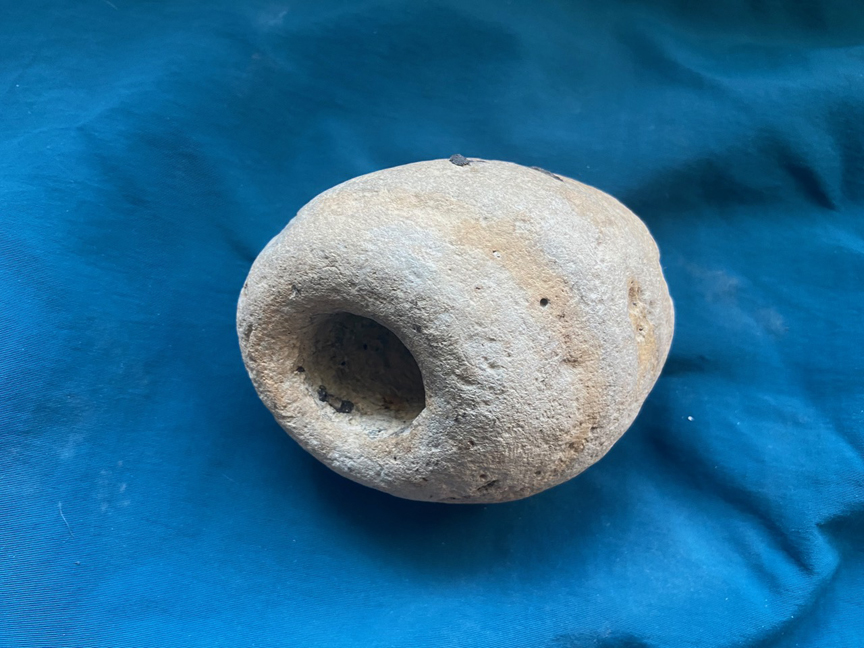
This rock is another Native American artifact. This one I found in a tidepool at Campus point by UC Santa Barbara, at very low tide. There was a huge Chumash settlement here when Europeans first arrived and no doubt this item was in use in those days. It's a weight to anchor a fishing net.

Display at Ganesh's Feet
From Budhi Gandaki River
Central Nepal
Finally, I include
this non-descript rock white rock, about 1 1/2 inches long by 1 inch tall, I collected while wading in the shallow edge of the Budhi Gandaki River that ran below the rice paddies through the Baseri Odare village, our trekking guide, Lokendra's home, in the foothills of the Himalayas.

Budhi Gandaki river rock

Budhi Gandaki River


Copyright © 2026 John Oliver
All Rights Reserved
mail@unclejohnsweb.com

Bricks and Rocks
Dickey Star firebrick 1927-1936
In about 1995, Johnny and I were exploring the Monterey Peninsula, Pacific Grove, Pebble Beach and Carmel. We had just come out of a great visit to the Monterey Bay Aquarium. It adjoins the Bay at the northwest end of Cannery Row. As we were walking back to where the truck was parked, there was an empty lot right on the bay and it was obvious a recent demolition of a historic Cannery Row building had taken place.
There were temporary construction site chain link fences around the lot and right along the sidewalk. Lo and behold, less than a foot inside the fence there lay an old brick emerging from the dust with some letters on it. Oh boy, I could reach it under the loose wire fence and pull it out. It says "Dickey Star" on it. A genuine relic of Cannery Row.
This is a Dickey Star firebrick from Livermore Fire Brick Works, W. S. Dickey Clay Mfg. Co. fired between 1927-1936, which coincides with John Steinbeck's portrayal of Cannery Row in 1945. With the rereading of his book, I may be able to narrow down which building it was.
It's been a custom of mine to bring a rock back as a souvenir of my travels, in these four cases, I brought back a brick. The three of them were fired at different brick works, at different times. Two of them from near Livermore in the valleys Northeast of San Jose, 20 miles from the south end of San Francisco Bay.
CH San Francisco City Hall 1874-1878
This brick is a well known artifact in the Bay area. The came from the Remillard Brick Company on the San Quentin Peninsula, on the bay, about ten miles north of the Golden Gate Bridge. It's around the corner from the prison that went into operation in 1848. The "CH" bricks were fired with the initials, "CH", for the building of the original San Francisco City Hall, from 1874 to 1878. When the city Hall was destroyed by the 1906 Earthquake, these commemorative bricks were gathered up from the rubble and sold as mementos, the money used in recovery efforts.
Pluto firebrick 1905-1917
This Pluto brick also has a connection with the great San Francisco Earthquake and Fire of 1906. After the devastation of the 1906 fire, replacing the wood framed structures with bricks became a popular and encouraged option. This Pluto firebrick came from The Steiger Terra Cotta & Pottery Company which had set up its timely brick works in nearby South San Francisco the year before the quake and fire. This particular brick must have been fired between 1905 and 1917.
A.P. Green Empire D.P. Firebrick 1923
I found this brick at my jobsite, a stately 1886 Victorian in Northern California, in 2023. It was fired in Mexico, Missouri, sometime after 1923, when its D.P. marking was copyrighted. The D.P. refers to Green's "Dry Press" method of forming the brick before firing using a mix with the very minimal water. This brick was used in a variety of fireboxes, from paddle wheel steamships and locomotive engines and industrial smoke stacks. How it got to Petaluma California 100 years later, unknowable.
Great Brick of China 1024-1644
Sitting on the speaker at the left end of our fireplace, a little grey fragment of a brick sits on a small black and maroon bag made of corduroy scraps with a blue drawstring to close it. Years ago, I was entering the MacDonald's in Carpinteria one morning to get quick meal. A young man was standing to the right of the door, in a position where you would commonly find some unfortunate person asking for a handout. This fellow had a different approach. He held out a small handmade bag, offering it for sale. The price? Whatever I wanted to pay for it. He said, "As long as you have this bag, you will never run out of money". I gave him enough to get the same breakfast I was about to have, and in the 30 years since that morning, it's been true.
In 2001, Johnny and I took a trip to China. Our self-scheduled itinerary and travel package included transportation, lodging and the first meal of the day at the hotel. Our time was our own to explore by our own whims whichever city we were in. We started with several days in Beijing. The Lonely Planet guidebook had pointed to an unexpected option. Hiking on the rough wall. Small sections of the wall have been restored and set up as tourist traps, with tour buses coming and going and vendors of every kind. The wall is over 13,000 miles long, and the restored sections are necessarily far between. Places where there is easy access to miles of mostly intact stairs, towers, and parapets of the wall which ran along the ridges as far as the eye could see. Some intrepid travelers hike and camp all along the sometimes crumbling for miles, days and weeks, but we were just there for the day. We had the hotel arrange for us to have a cab driver for the whole day who would drive us out through the countryside at Huangwa to a place the guidebook said we could get easy access.
The West Coast's Highway 101, from San Diego to Olympia, Washington, is 1540 miles long. The great Wall of China is 9 times that long. I say this to put into perspective the minuscule nature of the souvenir I'm about to describe.
As we were deciding that we had gone far enough and it was time to get turn back, it occurred to me that at this point I would ordinarily collect a rock that had some memorable quality that would remind me of far flung places. There weren't any rocks, per se, but dust and broken masonry. There was a broken corner of gray brick stair nosing worn smooth from countless footsteps, that had been there for 1000 years say, with a tiny spot of white mortar stuck to it. It was loose. I popped it into my fanny pack, saying, "This is going to fit in my charmed money bag."
Sure enough, it was the perfect size for the bag, and it's been part of our living room shrine to magic of all kinds for the last 25 years. The brick fragment reminds me of the labors of brick makers and masons in ancient China centuries ago, and to me, the bag itself is a powerful icon of self-respect. I honor the hands of their creators.
Footnote: I recently came across an article describing the secret ingredient in the Great Wall's mortar. Sticky rice! That's what the white specks on the brick are, sticky rice mortar.
Rocks
From Malpais Costa Rica
Malpais Mudstone Piddock Rock
This particular rock I found on a beach in Malpais, Costa Rica. It's common to find similar rocks with these kind of clam bored holes in them where I grew up in Southern California. The piddock clam starts as a larva in a tiny hole in some sort of mudstone or sandstone in the ocean water. As it filter feeds, it grows, twisting and wiggling to enlarge the hole until the chamber is larger than the opening. This rock had a jumble of fossil shells in the soft sedimentary stone so that when bored, the hole reveals a random cross section of cryptic designs. Some look like spirals, one looks like most of a peace symbol. One face of it appears like the primitive art of painted caves, or Queequeg's Tattoos in miniature. Look closely, this rock has a lot of mojo. The clams that sculpted this are themselves edible and have a bioluminescence. Pliny the Elder, the ancient Roman author and naturalist, wrote that those who ate these clams had mouths that glowed in the dark.
A closeup of the wetted stone reveals a pattern of cryptic symbols like an ancient cave painting, or the symbols on Queequeg's coffin.
From Northern California
Pomo Pestle
From Campus Point
UC Santa Barbara
Chumash fishing weight
Display at Ganesh's Feet
From Budhi Gandaki River
Central Nepal
Budhi Gandaki river rock
Budhi Gandaki River